Architecture
How data flows through asiai — from hardware sensors to your terminal, browser, and AI agents.
Overview
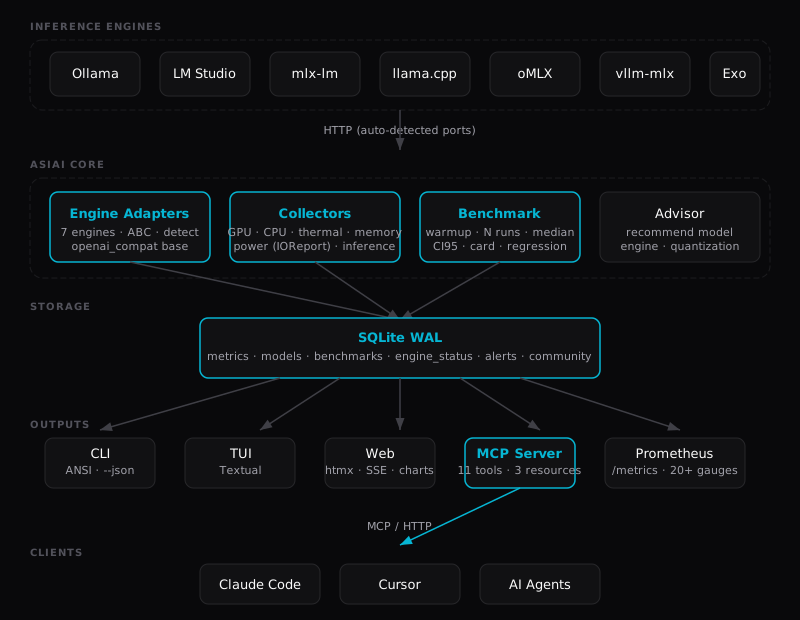
Key files
| Layer | Files | Role |
|---|---|---|
| Engines | src/asiai/engines/ |
ABC InferenceEngine + 7 adapters (Ollama, LM Studio, mlx-lm, llama.cpp, oMLX, vllm-mlx, Exo). OpenAICompatEngine base class for OpenAI-compatible engines. |
| Collectors | src/asiai/collectors/ |
System metrics: gpu.py (ioreg), system.py (CPU, memory, thermal), power.py + ioreport.py (GPU/CPU/ANE watts via IOReport), inference.py (TCP connections, Prometheus scrape), snapshot.py (full system snapshot). |
| Benchmark | src/asiai/benchmark/ |
runner.py (warmup + N runs, median, stddev, CI95), prompts.py (test prompts), card.py (SVG card generation). |
| Storage | src/asiai/storage/ |
db.py (SQLite WAL, all CRUD), schema.py (tables + migrations). |
| CLI | src/asiai/cli.py |
Argparse entry point, all 12 commands. |
| Web | src/asiai/web/ |
FastAPI + htmx + SSE + ApexCharts dashboard. Routes in routes/. |
| MCP | src/asiai/mcp/ |
FastMCP server, 11 tools + 3 resources. Transports: stdio, SSE, streamable-http. |
| Advisor | src/asiai/advisor/ |
Hardware-aware recommendations (model sizing, engine selection). |
| Display | src/asiai/display/ |
ANSI formatters (formatters.py), CLI renderer (cli_renderer.py), TUI (tui.py). |
Data flow
Monitoring (daemon mode)
Every 60s:
  collectors → snapshot dict → store_snapshot(db) → models table
                                                  → metrics table
  engines    → engine status → store_engine_status(db)
Benchmark
CLI --bench → detect engines → pick model → warmup → N runs
           → compute median/stddev/CI95 → store_benchmark(db)
           → render table (ANSI or JSON)
           → optional: --share → POST to community API
           → optional: --card  → generate SVG card
Web dashboard
Browser → FastAPI → Jinja2 template (initial render)
       → htmx SSE → /api/v1/stream → real-time updates
       → ApexCharts → /api/v1/metrics?hours=N → historical graphs
MCP server
AI agent → stdio/SSE/HTTP → FastMCP → tool call
        → runs collector/benchmark in thread pool (asyncio.to_thread)
        → returns structured JSON
Design principles
- Zero dependencies for core — CLI, collectors, engines, storage use only stdlib Python. Optional extras (
[web],[tui],[mcp]) add dependencies only when needed. - Shared Data Layer — The same SQLite database serves CLI, web, MCP, and Prometheus. No separate data stores.
- Adapter pattern — All 10 engines implement
InferenceEngineABC. Adding a new engine = 1 file + register indetect.py. - Lazy imports — Each CLI command imports its dependencies locally, keeping startup time fast.
- macOS-native —
ioregfor GPU,launchdfor daemons,lsoffor inference activity. No Linux abstractions.